Source Outdoor Neodymium Magnet Hook for Industrial, Household, and Motor Uses
Compare 30 listings for outdoor neodymium magnet hook options including N35 to N52 grades with nickel or zinc coatings. Buyers can evaluate customized sizes, shapes like hooks and cups, and applications across industry, food, and medical sectors with lead times of 15 to 25 days.
Key considerations
Products List



Comprehensive Sourcing Guide
Strategic Sourcing Guide for Outdoor Neodymium Magnet Hooks
Procuring outdoor neodymium magnet hooks requires a disciplined approach that balances the high magnetic strength of rare-earth materials with the harsh environmental realities of exterior use. Unlike indoor applications where humidity and temperature fluctuations are minimal, outdoor environments demand rigorous attention to coating integrity, corrosion resistance, and mechanical durability. The core keyword "outdoor neodymium magnet hook" points to a specific intersection of material science and industrial design where the permanent magnetic properties of sintered NdFeB (Neodymium-Iron-Boron) must be protected against oxidation. Buyers must navigate a landscape where the "Strong" and "Rust-Proof" attributes often cited in product listings are contingent upon specific manufacturing processes and post-production treatments. This guide outlines the critical technical, compliance, and operational factors necessary for a successful procurement strategy.
Technical Specifications and Material Integrity
The foundation of any reliable outdoor magnet hook lies in the base material and its geometric configuration. The supplied data indicates that the primary material is Sintered NdFeB Magnet, also referred to as Neodymium Magnet. This material offers the highest magnetic energy product available commercially, making it ideal for hooks that must support significant loads in compact forms. However, the raw sintered material is inherently susceptible to corrosion. To mitigate this, the manufacturing process typically involves a multi-stage approach: Sintering-Machining-Coating-Magnetizing-Packing. The coating is a non-negotiable specification for outdoor use. While some listings mention Nickel plating, others specify Zinc or Rubber Coating. For outdoor applications, the coating must be robust enough to prevent moisture ingress.
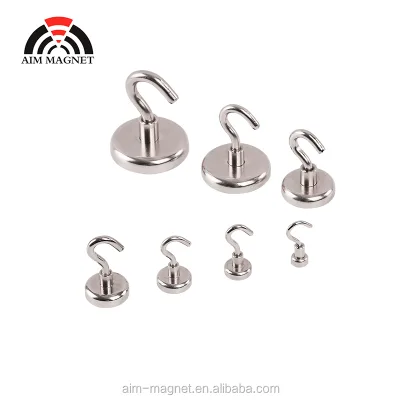
The shape of the hook is another critical variable. The observed product attributes include "Single Hook" and "Round" shapes, alongside "Cup Shape" variants. The geometry directly influences the magnetic field distribution and the mechanical stress points. A single hook design concentrates force at the tip, whereas a cup shape may offer a broader contact area. The tolerance for these dimensions is typically observed at +/-0.05mm, a precision level that ensures consistent fit and magnetic alignment. Buyers should verify that the specific hook design they select aligns with the intended load distribution. Furthermore, the magnetism direction is noted as "Alxial" (Axial), which dictates how the magnetic field is oriented relative to the hook's axis. This orientation is vital for ensuring that the hook pulls perpendicular to the mounting surface, maximizing holding power.
Environmental Durability and Performance Limits
When sourcing for outdoor environments, the working temperature and environmental resistance are paramount. The provided facts state a maximum working temperature of 80 degrees Celsius. While this is sufficient for many temperate climates, it is a hard limit that must be respected. In direct sunlight, metal surfaces can exceed ambient air temperatures significantly. If the hook is used in a region where surface temperatures might approach or exceed this threshold, the magnetic strength could degrade permanently. Buyers must assess the local climate data against this specification.
Corrosion resistance is equally critical. The product attributes list "Rust-Proof" and "Anti-Corrosion" as performance characteristics. However, these terms are observations of the product's intended capability rather than absolute guarantees for every unit. The effectiveness of these claims depends entirely on the quality of the coating process. The listed plating options include Nickel, Zinc, and Rubber. For outdoor use, a thick Nickel or specialized Rubber coating is generally preferred over standard Zinc, which may offer less protection in coastal or high-humidity environments. The "Rubber Coated Neodymium Magnet" mentioned in the data suggests a dual-layer approach where the rubber provides a physical barrier against impact and moisture, while the underlying metal provides the magnetic force. Buyers should request specific test data regarding salt spray resistance or humidity exposure for the exact coating type they intend to purchase, as the general term "Rust-Proof" does not quantify the duration of protection.
Compliance, Certification, and Quality Assurance
In the B2B procurement of magnetic components, certification serves as a proxy for manufacturing consistency and quality management. The observed certifications for these products include ISO9001, SGS, and ISO9001:2008. These standards indicate that the supplier has established a quality management system, but they do not guarantee the performance of every individual hook. ISO9001 focuses on the process control, ensuring that the sintering, machining, and coating steps are consistently followed. SGS is a third-party inspection body that often verifies product specifications.
Buyers must distinguish between the certification of the manufacturing facility and the specific test results of the product batch. The data mentions "Standard Export Package" and "Standard Export Carton Packing with Iron Shielding." The inclusion of iron shielding in the packaging is a specific detail that suggests a concern for magnetic interference during transport, which is a sign of a mature logistics process. However, for outdoor durability, buyers should verify if the supplier conducts specific environmental testing, such as salt spray tests (ASTM B117) or humidity tests, and request the results. The absence of specific test data in the general product listing means the buyer must explicitly ask for this documentation to ensure the "Rust-Proof" claim holds up under real-world conditions.
Cost Drivers and Pricing Variables
The pricing for outdoor neodymium magnet hooks is influenced by several dynamic factors. The observed price range in the market is broad, spanning from 0.07 to 50 USD. This wide variance is not indicative of quality alone but reflects differences in size, grade, coating complexity, and order volume. The material grade is a primary cost driver, with observed specifications ranging from N35 to N52, and specific mentions of N38-N52. Higher grades (e.g., N52) offer stronger magnetic force but are more expensive and slightly more brittle. The customization of the shape and size also adds to the cost. While the "Size" is listed as "Customized," standard sizes are typically more economical.
The Minimum Order Quantity (MOQ) is another significant factor, with observed ranges from 1 to 1000 units. For buyers testing the market or requiring small batches, an MOQ of 1 is advantageous, but the unit cost will be higher. Conversely, larger orders allow for better economies of scale. The lead time is observed to be 15-25 days, which is a standard window for custom manufacturing and shipping. Buyers should factor in this lead time when planning inventory, especially for seasonal outdoor products. Additionally, the "Customized" nature of the brand and design means that branding costs may be incurred if the buyer requires their logo or specific packaging. The "Polybag/Inner Box/Carton" options also add variable costs depending on the level of protection required for the destination market.
Supplier Evaluation and Operational Logistics
Evaluating a supplier for outdoor magnet hooks requires looking beyond the product listing to the operational capabilities. The origin of the products is frequently listed as Ningbo, Zhejiang, or generally China. These regions are hubs for magnet manufacturing, offering a mature supply chain for rare-earth materials. However, the "Customized" nature of the product means that the supplier's ability to manage small-batch customizations is crucial. Buyers should verify the supplier's capacity for "Customized Designs" and "Customized Magnet Size."
The transportation method is listed as "by Air or by Ocean." For outdoor hooks, which are heavy relative to their size, ocean freight is often the most cost-effective option for large orders, while air freight may be necessary for urgent, smaller shipments. The "Standard Export Package" is a baseline, but for outdoor products, buyers should consider if additional protective measures are needed to prevent damage during long sea voyages. The "New" condition of the products is a standard expectation, but buyers should ensure that the packaging prevents the hooks from shifting and damaging the coating during transit.
Typical Applications and Market Fit
The versatility of neodymium magnet hooks allows them to serve a wide array of applications. The observed application areas include Industry, Food Industry, Medical, Clothes, and Household uses. For outdoor contexts, the "Household" and "Industrial" categories are most relevant. In a household setting, these hooks might be used for hanging garden tools, outdoor decorations, or securing tarps. In an industrial context, they could be used for temporary holding of metal parts in outdoor assembly or for securing equipment in marine environments.
The "Food Industry" and "Medical" applications listed suggest that the hooks can be produced with coatings that meet hygiene standards, which is a useful secondary benefit for buyers looking for multi-purpose solutions. However, for outdoor use, the primary focus remains on the mechanical strength and environmental resistance. The "Single Hook" and "Round" shapes are particularly suited for hanging items where a single point of contact is sufficient. The "Cup Shape" might be better for applications requiring a flat mounting surface. Buyers should match the specific application requirements with the available shape and coating options to ensure optimal performance.
Long-Term Procurement Considerations
Sourcing outdoor neodymium magnet hooks is not a one-time transaction but a relationship that requires long-term planning. The "Customized" aspect of the product means that once a buyer settles on a specific design, coating, and grade, they should aim to maintain consistency in future orders to avoid quality variations. The "Brand" is listed as "Customized," which implies that the supplier can produce white-label goods, but the buyer must ensure that the underlying quality standards remain constant.
Future-proofing the procurement strategy involves monitoring changes in material grades and coating technologies. As environmental regulations tighten, the availability of certain plating materials may change. Buyers should maintain open communication with suppliers regarding the longevity of the coatings and the availability of alternative materials if current options become obsolete. The "15-25 Days" lead time should be built into the supply chain buffer to accommodate potential delays. Finally, the "Standard Export Carton Packing with Iron Shielding" suggests a high level of care in logistics, which is a positive indicator for long-term reliability. By focusing on these technical and operational details, buyers can secure a supply of outdoor neodymium magnet hooks that perform reliably in demanding environments.
FAQs
What coating options are available for outdoor neodymium magnet hooks?
Available coatings include Nickel, Zinc, and Rubber to ensure rust-proof performance. These layers protect the sintered NdFeB material from corrosion in humid or coastal environments. Buyers should verify the specific coating thickness for long-term durability.
Which maximum working temperature should outdoor hooks withstand?
The maximum working temperature is 80 degrees Celsius. Exceeding this limit in direct sunlight can permanently degrade magnetic strength. Ensure the local climate does not cause surface temperatures to surpass this threshold before installation.
Can I order custom sizes for these neodymium magnet hooks?
Yes, custom sizes and designs are available for industrial and household applications. The standard tolerance is +/-0.05mm to ensure precise fit. Customization allows for specific shapes like single hooks or cup shapes to match load requirements.
How long is the delivery time for custom orders?
The standard delivery time ranges from 15 to 25 days. This period covers sintering, machining, coating, and packing processes. Ocean or air transport options are available depending on the urgency and volume of the order.
What certifications do the magnet hook manufacturers hold?
Manufacturers typically hold ISO9001 and SGS certifications to ensure quality management. These standards verify consistent production processes for sintering and coating. Buyers should request specific test results for salt spray resistance to confirm outdoor durability.
What is the minimum order quantity for these hooks?
The minimum order quantity ranges from 1 to 1000 units depending on the supplier. Lower MOQs allow for market testing while higher volumes reduce unit costs. Pricing varies significantly based on the selected grade and customization level.
Which magnetic grade offers the strongest holding power?
Magnetic grades range from N35 to N52, with N52 offering the highest strength. Higher grades provide stronger force but may be more brittle. Select the grade based on the required load capacity and environmental conditions.